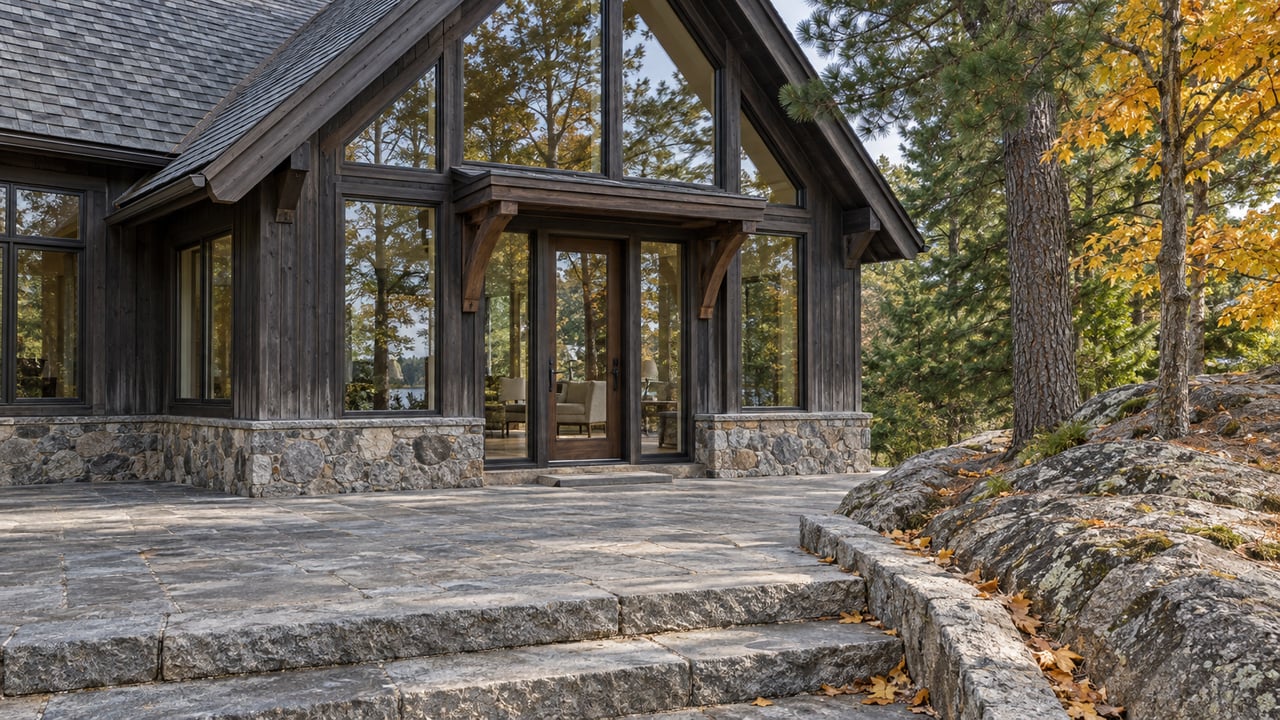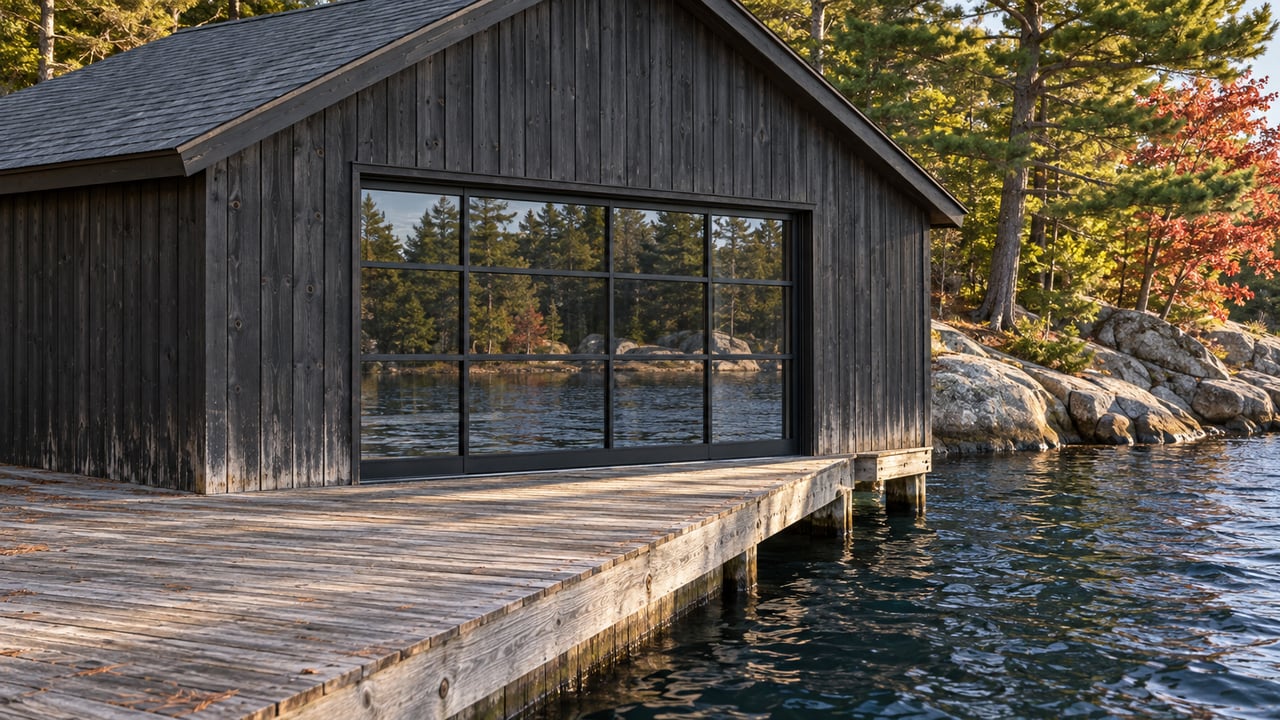
Walk the dock of a two-storey boathouse for sale on Rosseau's west shore this month and you'll likely hear the boathouse pitched as a selling point. The boathouse isn't valuable because of what it cost to build. It's valuable because the Township that governs this shoreline has spent the better part of four years trying to rewrite the rules, and as of this spring, that rewrite has been shelved until after an election most cottage buyers have never heard of.
That's the piece missing from most comparisons of Rosseau listings. Buyers price frontage, square footage, and dock condition. They rarely price the fact that the rules governing those structures are under review.
Why an older boathouse can carry a premium
Muskoka Deck and Dock describes shoreline structures as capped in total width, both as an absolute figure and as a percentage of a lot's frontage, with tighter limits again for anything built above a single storey.
That's why listings on Rosseau's Gold Coast and Tobin Island corridor lean so heavily on phrases like "historic boathouse" and "west-facing." The exposure sells the sunset. The boathouse sells the fact that the structure is already in place.
What the premium is actually worth
Per-foot pricing on Lake Rosseau has run roughly $12,000 to $22,000 in listings tracked through early 2026, with average waterfront values holding near $4.1 million over the same window. Those numbers already sit close to the top of the Muskoka market. What they don't show is where inside that range the money concentrates.
Buyers researching Rosseau tend to focus on the $3 million to $6 million band and treat it as one undifferentiated tier. It isn't. Within that band, a property with a documented, code-compliant boathouse and a west or south exposure routinely commands a premium over a comparable lot with a smaller, newer, or absent structure, even when frontage and square footage are close to identical. The entry-level luxury segment, roughly $3 million to $5 million, is where this shows up most clearly, because it's the price point where enough inventory exists to actually compare two similar cottages side by side and watch one outprice the other on structure alone.
That's the part a median price hides. A $4.1 million average tells a buyer nothing about whether the boathouse in front of them is an asset the seller can transfer cleanly or a liability wearing a nice roof.
| What's being compared | Priced like a feature | Actually priced like a permit |
|---|---|---|
| Two-storey boathouse | Amenity, added to comps | A feature to verify against its permit file |
| West or south exposure | Aesthetic preference | Compounds boathouse premium when paired with it |
| Frontage width | Straight per-foot math | A physical detail in the comparison |
| "Grandfathered" on a listing sheet | Reassurance | A claim that needs a permit file behind it, not just a seller's word |
The rulebook currently on pause
That uncertainty matters more on Rosseau right now because the rulebook is mid-rewrite.
The Township of Muskoka Lakes passed a zoning amendment in September 2022 that tightened restrictions on accessory buildings in Waterfront Residential zones, capping how many a property could have, how large they could be in total, and limiting height to a single storey with exceptions. But two of the most contentious pieces, the rules governing shoreline structures that exceed maximum permitted width and the broader accessory structures question, were deliberately pulled out of that 2022 amendment to be dealt with later. A local ratepayer group, Our Muskoka, has been tracking that unfinished business since it happened.
"Later" turned into a formal, multi-year process once the District of Muskoka approved the Township's new Official Plan on November 20, 2023, which under the Planning Act requires the zoning by-law to be reviewed for conformity within three years. The Township opened its Comprehensive Zoning By-law Update in phases, starting with the Waterfront Area provisions, the ones that directly govern boathouses, accessory buildings, sport courts, and shoreline development. Residents could book one-on-one consultations in July 2025 and attend an open house at the Port Carling Community Centre to review the options on the table. From there the Township moved into the Non-Waterfront Area half of the update, with a consulting planner presenting a formal recommendations report in April 2026.
At the most recent Planning Committee meeting, held May 14, 2026, staff were directed to fold the recommended changes into a first draft of the zoning amendment and to pause the entire project until after this fall's municipal election.
Why October 26 is the date that actually matters
The 2026 Ontario municipal elections page lists October 26, 2026, as the election date, with the new council term beginning November 15. That's the date the Township's own Planning Committee tied its zoning pause to, and it lands almost exactly a month from today.
For a Rosseau buyer, that means the current version of the waterfront rules remains in force through this fall's closings. It is not necessarily the version a newly seated council will inherit. Nothing in the public record says the incoming council will tighten shoreline structure rules further. Nothing says they won't. What the record does say is that staff were directed to prepare a first draft of the amendment covering exactly this question, with the project paused until after the election.
That's a different kind of uncertainty than a buyer's market or an interest rate cut. It's a specific, dated administrative fact, and it means the boathouse premium currently priced into Rosseau listings is, in part, a bet on how long the current rulebook survives.
What to actually check before you waive conditions
A few questions turn "grandfathered" from a listing adjective into a verified fact.
- Ask whether the boathouse's original building permit or documented approval is on file.
- Confirm in writing that the structure is recorded as legal non-complying, not simply assumed to be grandfathered because it's old.
- If any rebuild or expansion is planned, know that the Township's building by-law now requires a legal survey for redevelopment of legal non-conforming properties, specifically to establish what existed before demolition. Get that survey before you waive a condition, not after.
- Before closing, check the status of the Comprehensive Zoning By-law Update on the Township's Engage Muskoka Lakes page. A draft that's paused today can move quickly once a new council sits.
- If the boathouse involves any lakebed contact, confirm whether it falls under provincial Public Lands Act review in addition to municipal zoning. That's a separate approval layer with its own timeline.
Our own guide to boathouse and dock permitting across the Big Three lakes walks through the municipal and provincial layers in more detail, including how to read a permit file before you rely on it.
A few questions we hear often
Is this specific to Rosseau, or does it apply lake-wide across Muskoka? The Comprehensive Zoning By-law Update applies to the Township of Muskoka Lakes broadly, which covers the majority of Rosseau's shoreline along with most of Lake Joseph and Lake Muskoka. Portions of Rosseau and Joseph's north ends sit in Seguin Township, which runs its own separate zoning process.
A boathouse on Rosseau is never just a boathouse. It's a permit history, a frontage measurement, and right now, a bet on what a council not yet elected decides to do with a first draft still to come. If you're comparing listings on the strength of their shoreline structures, or wondering what your own boathouse's file actually says, The Blair Group can walk the permit history with you before you're deciding under a deadline instead of ahead of one.
This article is general information, not legal, tax or financial advice. Consult a qualified professional about your situation.