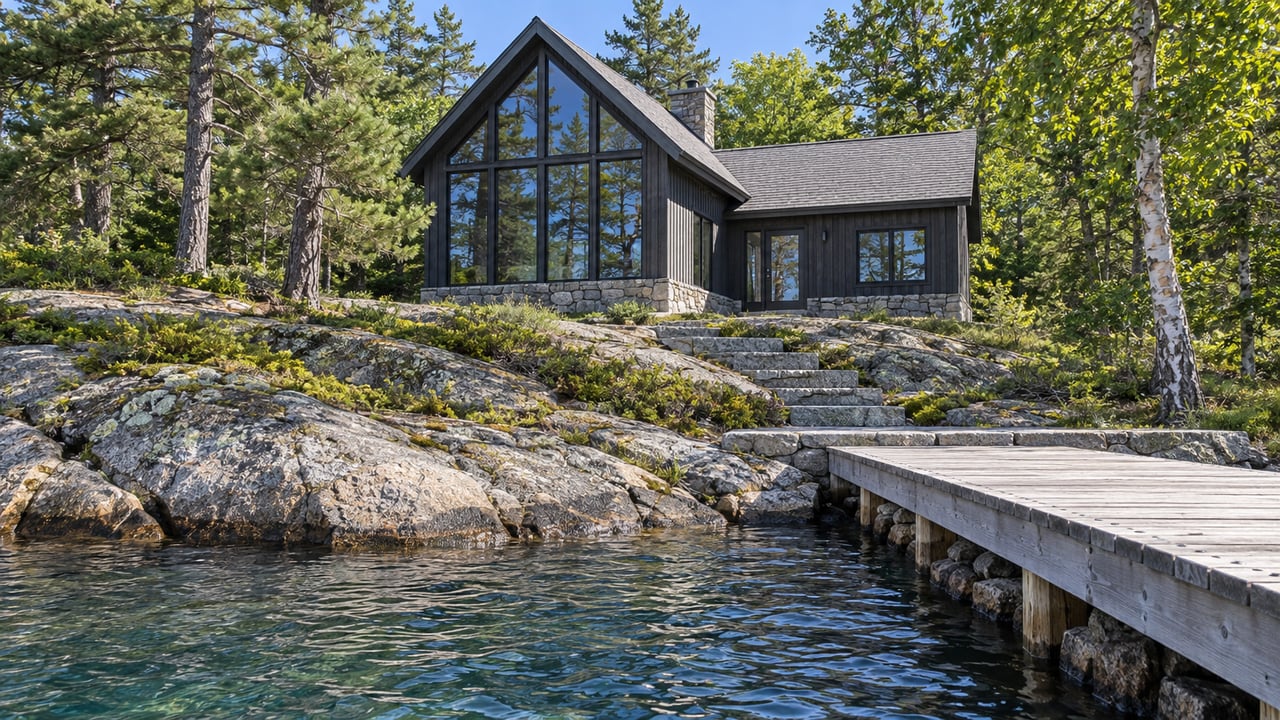
In early spring, an 11.3-acre property came to market on a secluded bay of Lake Rosseau. It had 602 feet of shoreline, a four-bedroom cottage and a two-storey boathouse, and the asking price was $8.999 million. In August the price came down to $8.699 million. In late September it sold at that reduced figure, The Globe and Mail reported in October.
The final price was $300,000 below the spring ask, a gap of about 3.3 percent. It took one price cut and roughly six months. If you plan to buy on Lake Rosseau this winter, that sale tells you more than the averages on the portals do. On a lake where so few properties trade, the useful signal is how each asking price moved on its way to a closing price.
Three prices for one property
The bay property carried three prices in one season: the original ask, a revised ask and the price recorded at closing. Each one tells you something different.
The spring price was the seller's opening position. The August cut came after the property had spent the whole summer on the market. The closing price matched the revised ask exactly. The buyer did not push below it, and the seller did not have to go lower. So the market's verdict was about 3 percent below where the seller started. It was not a deep discount.
Timing mattered too. The Globe's October piece described how buyers and sellers in cottage country often aim to have a deal in place before the clocks change and the first snow arrives. Agents told the paper that some sellers become more willing to negotiate or cut their asking price as the season winds down. The bay property followed that pattern, with a spring listing, a late-summer cut and an early-fall close.
Why the average moves with whatever happened to sell
A reported average keeps only the closing price of each sale and drops the path that led to it. That would matter less if many properties traded. On the Big Three, few do.
Paul Crammond, a broker with Chestnut Park, put it bluntly in the same Globe and Mail article: "It is a tiny market. Because it's such a small sampling, it's tough to get accurate stats." He noted that a handful of sales above $20 million can skew average prices for the whole area. He put the Big Three average at $2.1 million at the end of June 2026, up from $1.8 million at the end of 2025.
Lake Rosseau's recent history shows how far the mix of sales can move the numbers. In Chestnut Park's review of 2023 through 2025, reported sales on Lake Rosseau rose 288 percent in 2025 compared with 2023. Over the same period, the lake's average reported sale price came in lower in 2025 than in 2023. The report's explanation was that more sales, including lower-priced ones, pulled the average down. Rosseau and Lake Joseph still had the highest average sale prices among the Muskoka Lakes over those three years.
The same thing works in the other direction. A quiet year on the lake, with one or two exceptional estates selling, can lift the average when nothing about a typical shoreline has changed. A buyer who reads a rising Rosseau average as a reason to hurry, or a falling one as a reason to wait, is reacting to the mix of sales.
The averages also miss some deals entirely. On Lake Rosseau, Lake Joseph and Lake Muskoka, many waterfront properties sell privately or exclusively and never appear in the reported numbers. Chestnut Park has made this point in both its 2025 annual review and its July 2026 market update. We looked at how that plays out on Lake Joseph in an earlier post on the luxury tier there. For a Rosseau buyer, it means the public data is a thin sample of an already small market.
What happens when the gap is large
If the average says little, the gap between an asking price and a likely sale price says a lot. The bay property shows a deal with a small gap. Crammond described one with a large gap.
He told The Globe and Mail about first-time cottage buyers on the Big Three who paid above $10 million for a large family cottage with a garage and boathouse. It was built about ten years ago and listed in the spring at $13.5 million. Compared with other properties in that price range, he said, it "didn't measure up." He and broker Tracy Stewart showed the sellers the sale prices of comparable listings, and the sellers were willing to negotiate. The buyers had been searching for a few years, and that a gap this large between an asking price and a buyer's offer usually does not lead to a deal.
"At that level, the buyers are usually extra-sharp and looking for fair value," Crammond told the paper. He also said that properties priced accurately "do sell quite quickly – even over the $5-million and $10-million mark."
A listing priced close to its comparables can close within a few percent of its ask, as the bay property did after one adjustment. A listing priced well above its comparables can still sell, but only when the seller accepts a much larger move and a patient buyer brings the evidence. How long a listing has been on the market, and whether its price has changed, tells you which of those two situations you are in.
The supply sitting on the shelf going into winter
The broader Muskoka numbers matter for one reason: they show how many choices a buyer has, and so how much patience a seller can afford.
According to Chestnut Park's July 2026 update, new waterfront listings across Muskoka rose from 164 in July 2025 to 192 in July 2026, an increase of more than 17 percent. Active waterfront inventory reached 596 properties at the end of July 2026, almost 10 percent more than a year earlier. At the end of that month, the Muskoka Lakes waterfront market had 6.4 months of inventory. In the same report, reported waterfront sales in July 2026 were only slightly lower than a year earlier, and the average reported waterfront sale price rose 23 percent year over year, from $1.7 million to $2.1 million.
Crammond's figures for the first half of 2026 point the same way. Muskoka transactions fell about 4 percent from the first half of 2025, while new listings rose 3 percent. He said upper-tier prices had mostly held because luxury cottages on the Big Three are scarce.
Together, these figures describe a market where prices at the top have held while buyers have more to choose from than they did a year ago. In that kind of market, a seller at the top can afford one modest adjustment and still close, as the bay property's seller did, without the steeper declines Crammond described on Muskoka's smaller lakes. Those figures run through the end of July 2026, so treat them as the backdrop to this fall, not a reading of this week.
Reading a Rosseau listing this winter
For a buyer touring Lake Rosseau between now and spring, this changes the homework. The averages tell you which lakes sit at the top of the market, and Rosseau has been there for years. They cannot tell you what a particular stretch of shoreline is worth, because too few properties trade for that.
The useful work happens one property at a time. For any listing you are considering, compare its price history with properties that are truly comparable in frontage, acreage, exposure and the structures on the shoreline. A Rosseau boathouse carries its own premium, which we covered in a recent post on how those structures are priced. A spring listing that is still on the market after a full summer, with no price change, may be priced like the $13.5 million cottage. A listing that has already been adjusted once may be close to where the bay property ended up. A recent listing priced in line with its comparables is the kind Crammond said moves quickly, even in the eight-figure range.
The buyers in the Globe's $13.5 million account had been searching for a few years, and the comparable sales their brokers presented are what brought the sellers to the table. On a lake with this few sales, your best evidence is a set of good comparables. Our Lake Rosseau page and buyer's guide cover the bays and villages around the lake.
If you are weighing a Lake Rosseau listing this winter, or wondering where your own shoreline would sit between its asking price and its closing price, The Blair Group can walk you through the comparables that matter for that stretch of water. Request a confidential valuation or an exclusive listing preview, and we will start with the comparables for your bay.